
 Čeština
 Français
 Deutsch
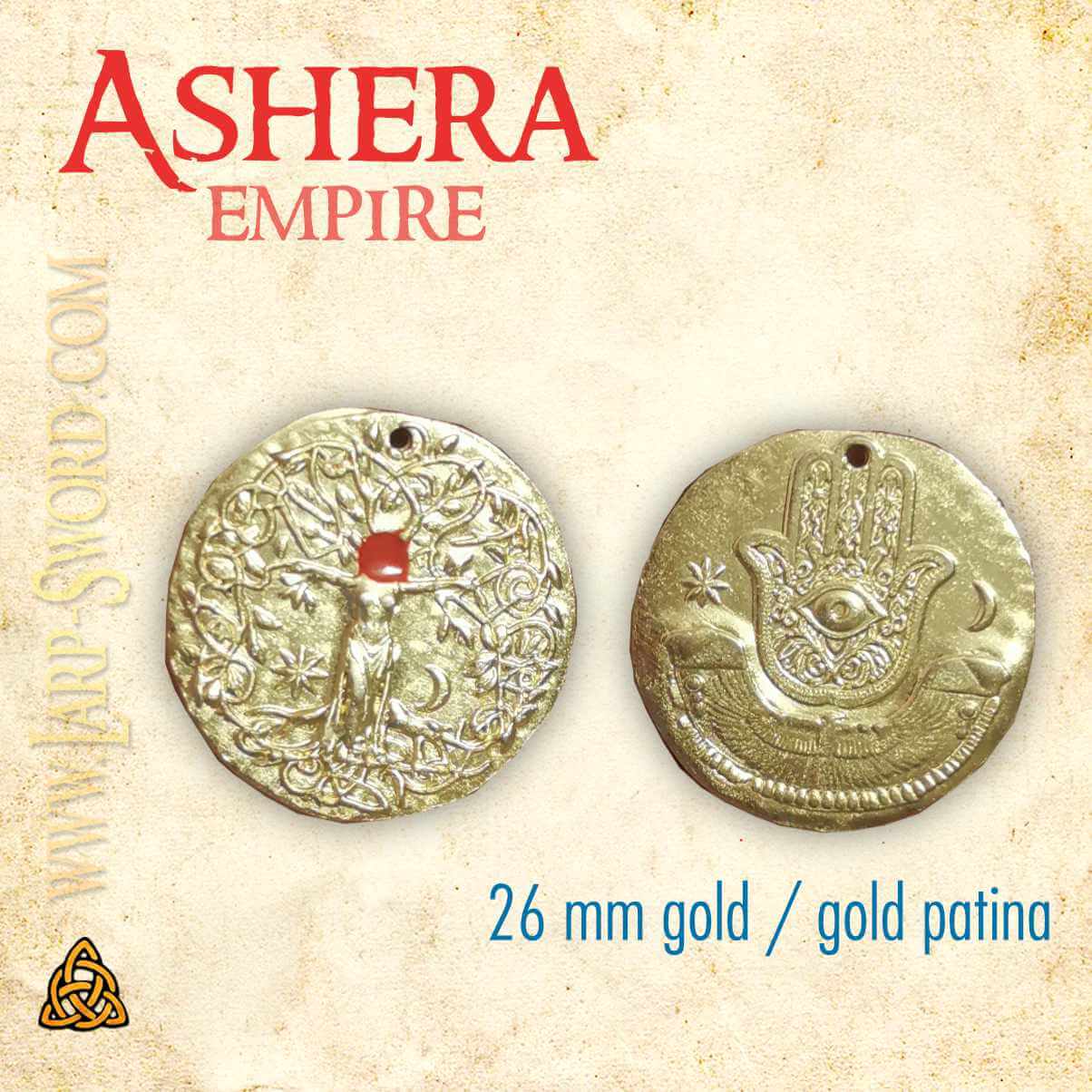
Ashera The Heavenly Mother
Price range: 49 Kč through 19.500 Kč
Ashera – The Heavenly Mother
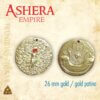
An artifact of a desert people who revere their goddess as a source of life, good fortune and fertility.
A coin that can also be worn in everyday life as a talisman.
Description
Ashera – The Heavenly Mother
An artifact of a desert people who revere their goddess as a source of life, good fortune and fertility.
A coin that can also be worn in everyday life as a talisman.
Ashera Empire
In worlds where the wind leans against the sand and the stars feel closer than cities, nomadic tribes wear the symbol of their heavenly mother close to their hearts.
Ashera.
An ancient goddess of life, relationships and fertility.
She holds the world together not by force, but by care.
Her sign appeared in ancient Near Eastern cultures among stars, sacred trees and female figures embodying life itself.
This artifact carries stylized Ugaritic symbolism — the Tree of Life, lunar signs, and a drop of red cold enamel evoking the spark of living energy.
In our larp worlds Děti nebe (Children of Sky) and Prométheové (Prometheus), it is worn by the desert people known as the “Children of the Sky” as a mark of belonging and protection.Beyond the game, it can serve as a personal talisman — a symbol of vitality, creativity and harmonious relationships.
Ashera is not a goddess of war.
She is a goddess of connection.
She is worn close to the heart.
Goddess Ashera
Ashera was an ancient Near Eastern goddess from the Levant, associated with fertility, motherhood and the Tree of Life.
In this fantasy interpretation, she becomes the heavenly mother of a desert nomadic people.
Who Was Ashera?
In pre-biblical and early biblical texts, Ashera appears either as an independent goddess or as the consort of the god El (Eloah) and mother of Baal and other deities.
In the archaeology and history of ancient Canaan, Ashera is recognized as a significant female divine figure. She is often associated with vegetation or represented symbolically as a Tree of Life.
Some inscriptions — notably from Kuntillet Ajrud — even refer to “Yahweh and his Asherah,” suggesting that certain early Israelite communities may have regarded her as a consort of Yahweh, a view later suppressed by official theology.
Cultic Symbols
- The sacred tree — often a living tree or wooden cultic pole near a temple or altar
- Fire and fragrant incense — offerings brought in ritual contexts
- Female priestesses or seeresses — frequently linked to lunar cycles, healing practices, and rites of passage
Symbolism
- Moon, Tree of Life, roots, water, blood, fertility, tears and prophecy
- Ashera may have been associated with life, death, and household protection
Ritual Practices
- Small domestic altars used for prayers concerning fertility, children’s health and protection
- Dances around sacred trees and transitional rites for women (menarche, childbirth)
Modern Echoes of Ashera
Today, the figure of the ancient goddess returns more as an archetype than as a religion. She evokes the need for balance — between strength and care, achievement and relationship, the world we build and the world we protect.
This is not a revival of an ancient cult, but the re-emergence of a symbol that speaks to something deeply human: the need for connection and meaning.
Ashera no longer lives in temples, but in stories, music and symbols — in literature, games and art. Sometimes as a historical figure, sometimes as an image of balance between masculine and feminine principles.
A deeper exploration of her historical and symbolic dimensions can be found in the book Svět podle Ašéry (The World According to Asherah). Her motif also appears in contemporary music — and sometimes even a song can become “cult.”
Interesting Parallel
The Norse world tree Yggdrasil embodies the same archetypal concept of the cosmic Tree of Life as the tree associated with Ashera.
Additional information
| Weight | N/A |
|---|---|
| Color | Gold, Patina gold |
| Žánr/období | Fantasy worlds, Greece, Rome, Celts, ancient |
| Váha | |
| Estetika | Archaic, Faithful fantasy world |
| Kompatibilní světy | Ancient, Ashera empire, Fantasy and cinematic |
| Množství v balení | 1 pc, 10 pcs, 100 pcs, 2 pcs pair |
| Materiál | zinc aloy |
Related products
Souvenir shop
Coins